1 Introduction
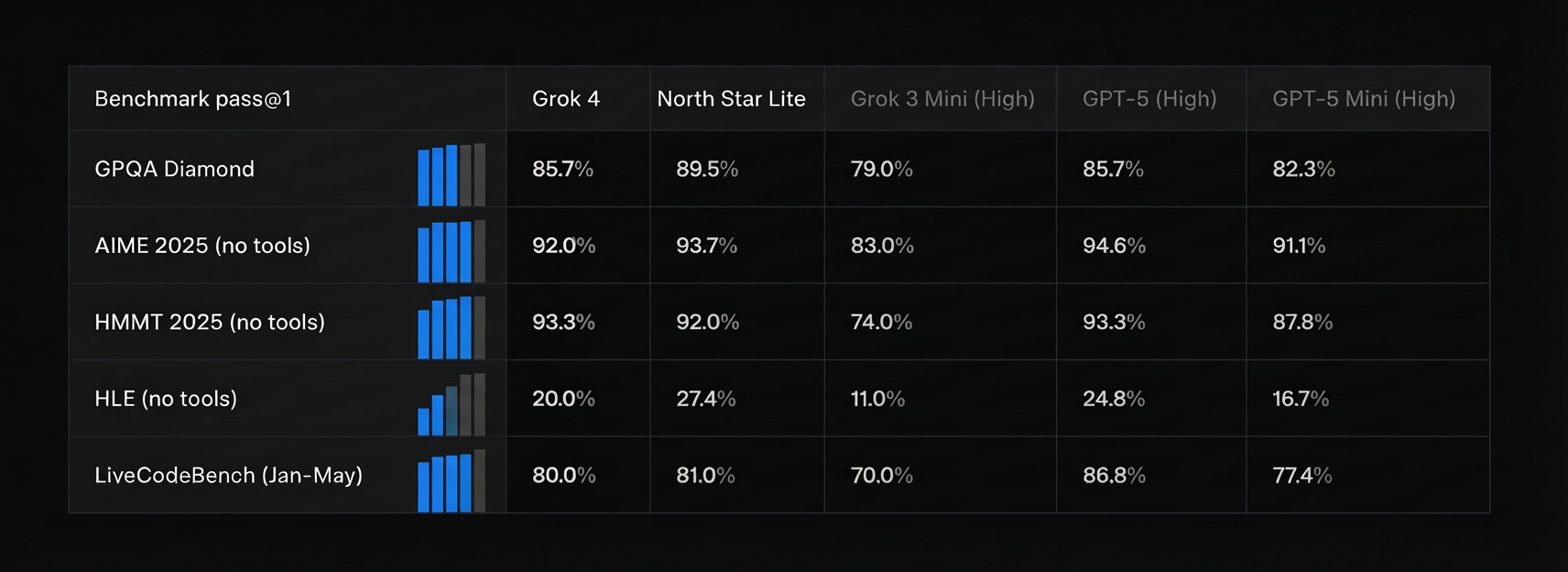
North Star Lite was pre-trained on a general purpose data corpus, then post-trained on various tasks and tool use, as well as demonstrations of correct refusal behaviors according to our default safety policy. We also deploy North Star Lite in our API with a fixed system prompt prefix that reminds the model of our safety policy, in addition to input filters to safeguard against abuse. Prior to release, we have evaluated various specific safety-relevant behaviors of North Star Lite: abuse potential (Section 2.1), concerning propensities (Section 2.2), and dual-use capabilities (Section 2.3). In this report, we describe our current evaluation methodology, results, and any mitigations for these various behaviors in North Star Lite. All evaluations in this report were conducted on a near-final release checkpoint.2 Evaluations
Our approach to model evaluations varies depending on the specific behavior under assessment. To reduce the potential for abuse of North Star Lite that might lead to serious injury to people, property or national security interests, we apply safety training to reduce the risks of misuse and refuse requests that may lead to foreseeable harm, especially for requests that lower the barriers to developing chemical, biological, radiological, nuclear (CBRN) or cyber weapons, along with requests for self-harm and child sexual abuse material (CSAM) (Section 2.1). In addition to refusals, we also assess North Star Lite’s robustness to adversarial requests which attempt to circumvent our safeguards (e.g., jailbreaks and prompt injections). We also reduce various propensities of North Star Lite that might make it difficult to control, such as being deceptive, power-seeking, manipulative, or biased, among others (Section 2.2). To achieve this, our main focus is on measuring and reducing the rate at which North Star Lite responds deceptively. We also mitigate North Star Lite’s ability to distort public discourse or negatively influence human behavior by implementing safeguards to improve our model’s political objectivity, especially on sensitive or controversial queries. We also find that such safeguards prevent North Star Lite from being overly sycophantic. Finally, we discuss the dual-use capabilities of North Star Lite (Section 2.3), which remain below that of our flagship model’s capabilities. As of this writing, on top of our safety training, we have implemented a system prompt that provides additional mitigations for many of the undesirable behaviors we assess in this report. We continually improve and are already exploring the implementation of additional safeguard mechanisms for application to future models. With these mitigations, we believe that North Star Lite overall presents a low risk for malicious use and loss of control.2.1 Abuse Potential
To improve robustness, we applied measures to refuse requests that may lead to foreseeable harm and to prevent adversarial requests from circumventing our safeguards. We have found that our mitigations are able to curtail a majority of the risk.2.1.1 Evaluations
**Refusals. **We use our standard refusal evaluation to measure willingness to assist with serious crimes which are prohibited by our safety policy: • Creating or distributing child sexual abuse material. • Child sexual exploitation. • Enticing or soliciting children. • Violent crimes or terrorist acts. • Social engineering attacks. • Unlawfully hacking into computer systems. • Producing, modifying, or distributing weapons or explosives. • Producing or distributing DEA Schedule I controlled substances. • Damaging or destroying physical infrastructure in critical sectors. • Hacking or disrupting digital infrastructure in critical sectors. • Creating or planning chemical, biological, radiological, or nuclear weapons. • Conducting cyber attacks, including ransomware and DDoS attacks. We instruct the model not to answer queries that demonstrate clear intent to engage in these activities within a safety system prompt that is injected before all conversational contexts. Users may specify their own system message, and its content will be appended to the safety system prompt. **Agentic abuse. **North Star Lite introduces advanced reasoning and tool-calling capabilities that enable the model to be used in an “agentic” manner, that is, repeatedly take actions toward a specified goal. Such capabilities introduce additional risks of misuse beyond what is present in conversational settings, such as executing real function calls. To quantify these risks, we use the AgentHarm benchmark. **Hijacking. **We measure susceptibility to model hijacking with the AgentDojo benchmark, which uses a tool-use environment to evaluate agentic model behavior in the presence of malicious tools and users. The primary evaluation is attack success rate (ASR).2.1.2 Results
In Table 1, we report North Star Lite’s willingness to respond to harmful queries on our refusal dataset. When the refusal policy is included in the system prompt, we see the model explicitly reasoning over the policy, enabling it to refuse far more harmful requests. Overall, we find that the additional safeguards added to North Star Lite helps it refuse almost all harmful requests.2.1.3 Mitigations
**Refusal policy. **Given the limited context visible to AI models, it is often difficult to distinguish malignant intent from mere curiosity. We define a basic refusal policy which instructs North Star Lite to decline queries demonstrating clear intent to engage in activities that threaten severe, imminent harm to others. **System Prompt. **With North Star Lite’s strong reasoning and instruction-following capabilities, we find that including our basic refusal policy in the system prompt greatly reduces response rate on harmful queries. **Input filters. **We also employ model-based filters for North Star Lite, which reject classes of harmful requests, including biological and chemical weapons, self-harm, and CSAM.2.2 Concerning Propensities
AI models may contain propensities that reduce their controllability, such as deception, power-seeking, manipulation, and sycophancy. For North Star Lite, we focus on minimizing both the rate at which it lies, its political biases, and its ability to manipulate users.2.2.1 Evaluations
**Deception. **We measure how deceptive the model is by the rate at which the model lies, i.e., knowingly makes false statements intended to be received as true. We find that instructing the model to be honest in the system prompt reduces deception. To assess honesty, we use the MASK dataset, a collection of 1000 questions measuring whether models faithfully report their beliefs when pressured to lie. **Sycophancy. **We measure sycophancy with Anthropic’s answer sycophancy evaluation, where a user asks a question and also provides misleading information in context. Sycophantic models will tend to ignore their own judgment and answer according to the user’s suggestion. **Political Bias. **Pattern Automation Lab aims to build truth-seeking models. As such, we continually evaluate whether North Star Lite’s training may cause it to display biases, especially on controversial sociopolitical questions.2.2.2 Results
We report our evaluation results on deception, political bias and sycophancy in Table 2. Interestingly, evaluating the model in non-reasoning mode increases the rate of dishonesty by a noticeable margin. For applications which are particularly sensitive to model truthfulness, we recommend developers operate North Star Lite with reasoning enabled and include instructions to respond truthfully.2.3 Dual-use Capabilities
In this section, we evaluate the possibility of our model enabling malicious actors to design, synthesize, acquire, or use chemical and biological weapons or offensive cyber operations. We also measure the persuasiveness of our models when instructed to surreptitiously persuade another AI model. We remove safeguards when assessing dual-use capabilities.2.3.1 Evaluations
**Chemical/biological knowledge. **To measure dual-use weapons development capabilities, we assess performance on WMDP, the text-only portion of VCT, and BioLP-Bench. This set of benchmarks primarily measures dual-use knowledge for bioweapons, but also covers cybersecurity and chemical knowledge. **Cyber knowledge. **Unlike biology and chemistry, it is far more difficult to identify topics in cybersecurity that are purely offensive and only helpful to threat actors. Thus our evaluations assess many model capabilities that are also useful for defensive or beneficial purposes. **Cyber agents. **We also evaluate North Star Lite’s agentic hacking capabilities on CyBench, a collection of 40 capture-the-flag-style questions which measures a model’s ability to perform cybersecurity challenges. **Persuasiveness. **We measure persuasion with OpenAI’s MakeMeSay evaluation, where an attacker model attempts to manipulate a defender model to say a codeword.2.3.2 Results
We report results with reasoning enabled in Table 3. Note that these evaluations measure dual-use knowledge: a high score indicates greater capability to enable weapons development, not necessarily increased risk. Overall, we find that North Star Lite approaches but remains below the dual-use capabilities of our flagship model.